Print sales of Magonomia paused

Print sales of Magonomia® the RPG of Renaissance wizardry are currently paused. We’ve uploaded new digital content files to our print-on-demand partners including corrections to the Map of Enchanted England on p. 284. We’ve ordered proofs, which is publishing jargon for a print copy to make sure the printing came out right. Sales are on pause until the proofs are approved. We expect this will be 2-3 weeks.

Image of Magonomia Core Rules book.

The Magonomia Experience

We’re getting started on a lighter Quick Start for Magonomia that will be an easier entry to the game than the Starter Rules. The first page explains what Magonomia is like, so the reader can decide whether there’s any point in reading further. Here’s the first draft:


Illustration by Teresa Guido, ©2020 Shewstone Publishing LLC

Learning a new roleplaying game is an investment of your time (and money). It’s fair to ask what the game will be like once you’ve learned it.

Presumably you know the basic premise that everyone plays a wizard in a fantasy version of Renaissance England. Beyond that:

  • The magic is based on authentic sixteenth-century folklore. If feels like the magic portrayed in Shakespeare’s plays, rather than modern fantasy movies. Your wizard won’t be throwing fireballs. They’re more likely to fly on a broomstick or to brew a potion that grants superhuman strength.

  • Your wizard will start with a repertoire of 11 spells, chosen from a list. Each spell does one specific thing, such as turning your character invisible or detecting curses.

  • Teamwork is key. Because everyone plays a wizard, there are five varieties of magic to choose from, each with its own strengths and weaknesses.

  • The mechanics are based on the Fate™ system, specifically Fate Condensed. This is a skill-based system with improvisational elements.

Magonomia is a good choice for you if:

  • You’re captivated by the lore from when Europeans thought magic and faeries were real.

  • An all-wizard campaign sounds awesome to you.

  • You like to think creatively while using your character’s powers and abilities.

  • You like to immerse yourself in the scene your character is experiencing.

Magonomia may not be to your liking if:

  • Power gaming is your thing.

  • You like realistic adventures better than magic. Magonomia is about wizards.

  • You prefer lightweight rules that you don’t have to think about.

  • You dislike games where your character’s plan goes sideways.

Pregenerated character index on Magonomia® wiki

Following up last week’s article about Gemini : we actually have published quite a few ready-made PCs for Magonomia, between the Starter Rules, Early Access, and now the Core Rules Example characters.

We’ve made a list of all the published characters on the Magonomia wiki, including where to download them and what (if any) changes are needed to bring them up to date to the final, published Core Rules.

These should help you get started quickly with a published adventure or homebrew one-shot. Enjoy!

Magonomia® Example Character: Gemini

In Magonomia® the TTRPG of Renaissance wizardry, everyone plays a wizard. We created five different wizard characters (one for each Science) and used them in examples throughout the core book. You can now download these example characters as part of your Core Rules purchase, or from this link (no purchase necessary).

Over the next several weeks we’ll introduce each of these characters in a blog post, explaining their motivations, skills, and, of course, their magical powers. Since last Thursday was International Transgender Day of Visibility, let’s start with our nonbinary example PC, Gemini!

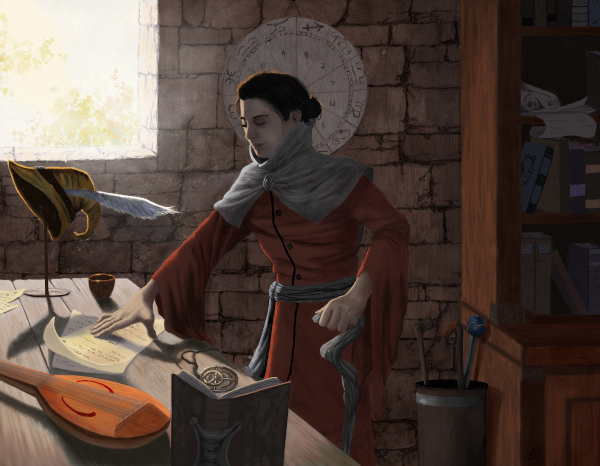
Image of Gemini, an androgynous wizard at their laboratory workbench.

Gemini in their laboratory. Illustration by Jeff Koch.

Gemini is the detailed example of character creation in Magonomia Core Rules, pages 26-35. They’re an astrologer, a polymath, and a bibliophile. As much as Gemini loves books, they aren’t a recluse: a good character design provides a motivation to get the character out into the world, and Gemini has a big one. Their High Concept is Upwardly Mobile Renaissance Person. Gemini is someone who seeks —and gets— the patronage of powerful people by being smart, charming, and capable. Part of the idea is that Gemini can get missions from current and future patrons, if the GM ever needs an easy story hook. What GM wouldn’t appreciate that?

Gemini is gender fluid, one specific kind of gender nonconformity meaning their gender identity changes over time. Gender identity is not the same thing as gender expression. We chose gender-neutral pronouns and an androgynous look for Gemini, while recognizing that real-world gender fluid people express their gender in a variety of ways.

This character is built on the Visionary archetype (page 50), which falls under the Science of Astrology. Archetypes are optional templates for making a character that fits a particular theme. The Visionary is someone who seeks power as a means to some higher ideal. We didn’t pin down exactly what that higher ideal is, because we didn’t want to give a false impression that Magonomia is supposed to be “about” a certain kind of story. Note that Gemini is a complete character, ready to play, without even deciding on that. In a real Magonomia game, the player would get the opportunity to gradually revise the character’s Aspects over time. It might be best to let the character fit into the world a bit and add that detail when the time is right.

Their best spell is Portent of the Opposing Stars. This is a Divination that describes one of the major obstacles to a specific goal. For example, suppose the character needed a certain rare book of magic (another of their Aspects is You Can Never Have Too Many Books) but the bookseller wouldn’t admit they had a copy for sale. Portent of the Opposing Stars might reveal that the bookseller was being obstructive because the rare book had been stolen! Another possible use might be in searching for the thief: after the first couple of leads run dry, Gemini could cast Portent of the Opposing Stars to discover that the thief is using magic to cover their proverbial tracks.

As you can see, Portent of the Opposing Stars can expose new plot events and really change up the narrative. That’s why that spell costs a Fate Point. The GM is encouraged to make sure Divination spells always reveal some useful information, but they also have a veto power to return the player’s Fate Point if they can’t think of a spoiler-free way to reveal useful information.

Gemini is designed for stories involving investigation and social interaction. Their forte is helping the players deal with the unexpected. Astrology does have some spells that can help in a fight: Discovering Achilles’ Heel is one such example. (If you know who you’re going up against, it can reveal an exploitable weakness.)